




- sales/support
Google Chat:---
- sales
+86-0755-88291180
- sales01
sales@spotpear.com
- sales02
dragon_manager@163.com
- support
tech-support@spotpear.com
- CEO-Complaints
zhoujie@spotpear.com
- Only Tech-Support
WhatsApp:13246739196
- Purchase/Shipping/Refund
WhatsApp:13424403025
- HOME
- >
- ARTICLES
- >
- Jetson Series
- >
- Jetson Kits
Jetson-nano-to-boot-the-system User Guide
Introduction
Herein mainly introduces Jetson Nano modules with 16GB eMMC memory according to official nvidia tutorial. All information is subject to the official website of nvidia.
Reference Links
- https://developer.nvidia.com/embedded/learn/get-started-jetson-nano-devkit#write
- https://docs.nvidia.com/jetson/archives/l4t-archived/l4t-3261/index.html#page/Tegra%20Linux%20Driver%20Package%20Development%20Guide/flashing.html#wwpID0E01O0HA
Hardware Preparation
- Jetson Nano module, corresponding power supply and heatsink
- Ubuntu18.04 computer host
- U disk with USB interface or mobile hard disk (USB3,0 is recommended)
- a USB data cable (Micro USB interface, for transmitting data)
Software Preparation
- Install SDK Manager and flash system configuration for Jetson Nano.
- Tutorial: SDKM flash Nano
- Record the address of the downloaded HW Imager during the flashing process for later.
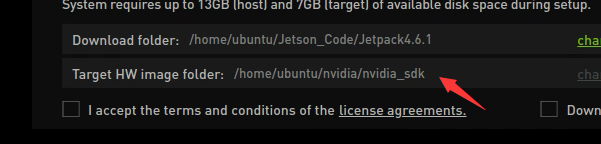
- Connect the U disk to the nano, and check the device number of it in the nano, such as sda.
ls /dev/sd*
- Insert the U disk to the ubuntu computer.
- Check the device number of the U disk on the computer, such as sdb.
sudo lsblk -p -d | grep sd
- Note: If your U disk has been partitioned before, it is recommended to format and adjust it to a partition on another computer first.
- Format the USB drive to ext4
sudo mkfs.ext4 /dev/sdb
- Note: Please refer to your actual situation for the specific device number. Some devices may be sda or others.
- Mount U disk
sudo mount /dev/sdb /mnt
- Enter the HW Imager address and copy the rootfs.
cd <path>/Linux_for_Tegra/rootfs/
- Note: Please refer to your actual address. For example, the author's path command:
cd/home/ubuntu/nvidia/nvidia_sdk/JetPack_4.6.1_Linux_JETSON_Nano_TARGETS/Linux_for_Tegra/rootfs/
- Copy the file system to the U disk.
sudo tar -cpf - * | ( cd /mnt/ ; sudo tar -xpf - )
- After finishing the copy, unmount the U disk, (note: don't pull it out).
sudo umount /mnt
- Set up nano as recovery mode (refer to the flashing tutorial), then connect it to the ubuntu computer and input the flashing command.
cd ../
csudo ./falsh.sh jetson-nano-emmc sda
- Note: Sda should be filled in as the actual device number of the U disk recognized by nano in the first step.
- After flashing, disconnect the nano and the U disk. Insert the U disk to the Nano before powering on it, and follow the prompts to complete the configuration.
TAG:
Raspberry Pi 5 Argon-NEO-M.2-NVME-PCIE-Expansion-Board Only For Argon NEO 5 Case (Not include)
Raspberry Pi 18.5 inch Type C/HDMI/4K Display Screen 3840×2160 Computer PC Phone Xbox/PS4/Switch
Raspberry Pi 4 Camera
Raspberry Pi USB Global Shutter Camera 1MP OV9281 120fps Black/White 120fps also For Jeston RDK
Raspberry Pi DSI LCD
Raspberry Pi 5
XIAO RA4M1 Tiny SuperMini Board For Arduino Uno IDE For SeeedStudio R7FA4M1
RS232 to Ethernet
Modbus RTU Relay 32CH
Arducam
Gyroscope
ESP32-S3 QMI8658A
2.15 inch e-Paper HAT+ B E-Ink Red/Black/White 296×160 Screen Display For Arduino /Raspberry Pi /Jetson Nano /STM32
ESP32 S3 AI 1.75 inch Development Board with 1.75inch AMOLED Touchscreen Round Screen Deepseek
Modbus POE ETH Relay Waveshare User Guide
1.28 inch Round Rotary LCD Smart Screen 1.28inch Knob Display 240x240 Option Touch/No-Touch
Raspberry Pi Pico 2 RP2350 With 0.96 inch LCD Display 0.96inch Screen 160×80 Onboard RP2350A
Wiki
Pi5 Double 2280
ESP32-S3 Industrial-Grade IOT RS485 CAN Communicator WiFi Bluetooth
TAG:
Raspberry Pi Zero UPS 26650 Li-Battery
Milk V Duo
RP2040 LoRa-HF
Raspberry Pi 3.5 inch e-Paper link (G) RYBW 384x184 For Arduino / Jetson Nano / STM32
Jetson Nano Module
Spotpear
SpotPear
Raspberry Pi Pico
7inch Round LCD HDMI Capacitive 7 inch Touchscreen Display 1080x1080 For Raspberry Pi/Jetson Nano/mini PC
ESP32-H2-MINI-1-N4
LCD
DeepSeek ESP32-S3 Voice Chat Robot 0.85 inch LCD
DeepSeek ESP32-S3 Voice Chat Robot
ESP32-S3 1.28inch Round LCD Display TouchScreen Accelerometer Gyroscope Sensor Case
Raspberry Pi Monitor DisplayScreen 15.6 inch LCD
Raspberry Pi 5 case
Development Board
Raspberry Pi Pico 2 RP2350 0.85 inch LCD Display Development Board
JETSON NANO IO BASE Board
Raspberry Pi Display