- sales/support
Google Chat:---
- sales
+86-0755-88291180
- sales01
sales@spotpear.com
- sales02
dragon_manager@163.com
- support
tech-support@spotpear.com
- CEO-Complaints
zhoujie@spotpear.com
- Only Tech-Support
WhatsApp:13246739196
- Purchase/Shipping/Refund
WhatsApp:13424403025
- HOME
- >
- ARTICLES
- >
- Common Moudle
- >
- WIFI
Core1262-868M User Guide
Introduction
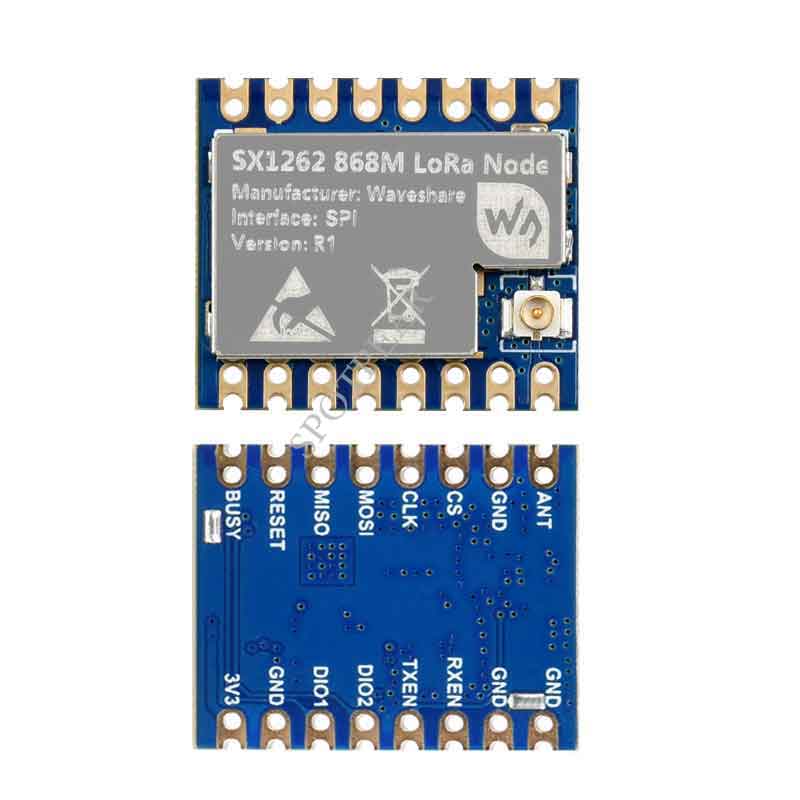
Core1262-868M is a LoRa core module that incorporates a new-generation SX1262 chip. It is mini and features long-range transmission, high anti-interference capability. The module uses EU868 band, and combined with LoRa gateway, it can be connected to servers like TTN server to build LoRa network.
Features
- The new generation SX1262 is more power-efficient and transmits longer distances than the SX1278.
- Applicable to EU868 frequency band, combined with LoRa gateway, fast access to cloud servers such as TTN.
- Provide complete supporting information manuals (STM32, Raspberry Pi Pico, and other sample programs and manuals, etc.).
Parameter
| Electric | Parameter |
| RF Chip | SX1262 |
| Operating Frequency | EU868 (863~870MHz) |
| Modulation | LoRa/(G)FSK |
| Emit Power | >14dBm@3.3V |
| Operating Voltage | 5V |
| Module Current | Emit current:45mA@14dBm<br\>Received current:5.3mA@125KHz |
| Communication Bus | SPI |
| Operating Temperature | -40 ~ 85℃ |
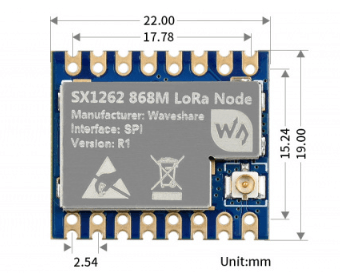
| Dimensions | 19.00 × 22.00mm |
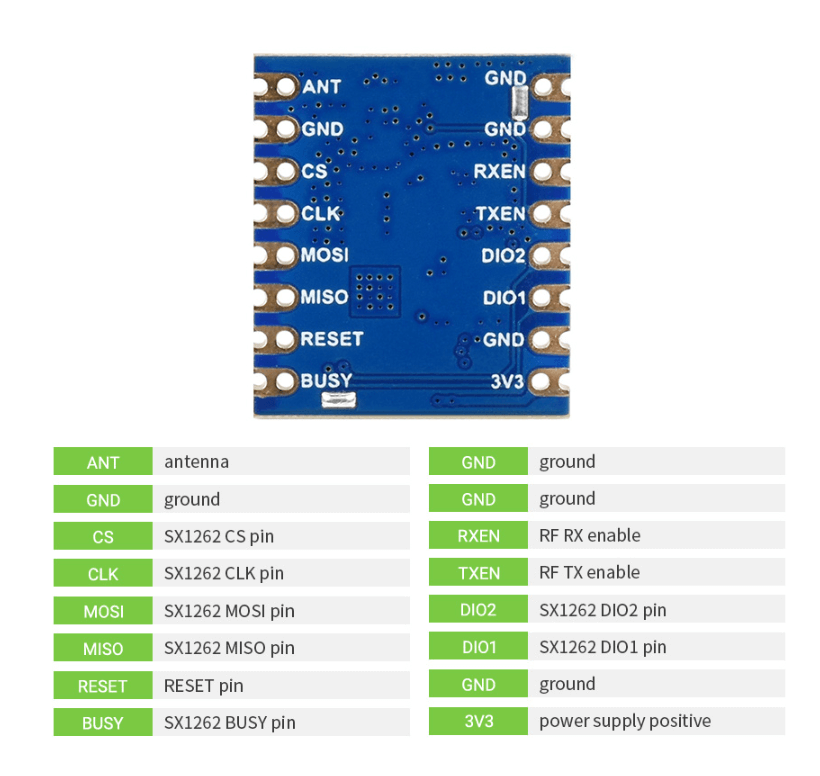
Pinout Definition
Dimensions
LoRa & LoRaWAN
What is LoRa ?
[Semtech]'s LoRa is a long-distance, low-power wireless platform for the Internet of Things (IoT), which generally refers to radio frequency chips using LoRa technology. The main features are as follows:
- The spread spectrum modulation technology used by LoRa (abbreviation of long range) is derived from chirp spread spectrum (CSS) technology, which is one of long-distance wireless transmission technology and LPWAN communication technology. At present, LoRa mainly operates in the ISM frequency band, mainly including 433 , 868, 915 MHz, etc.
- LoRa technology integrates technologies such as digital spread spectrum, digital signal processing and forward error correction coding, which greatly improves the performance of long-distance communication. LoRa's link budget is better than any other standardized communication technology. The main factors that determine distance in a given environment
- LoRa RF chips mainly include SX127X series, SX126X series, SX130X series, of which SX127X, SX126X series are used for LoRa nodes, and SX130X is used for LoRa gateways. For details, please refer to [Semtech]'s product list
What is LoRaWAN ?
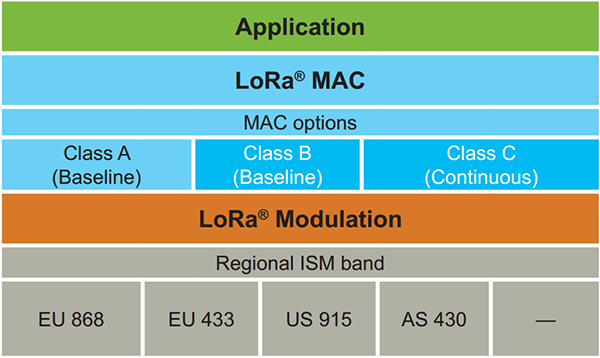
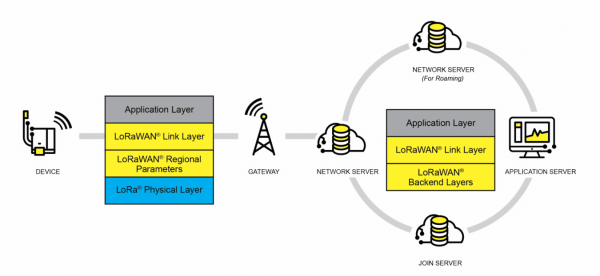
- [LoRaWAN] is a low-power wide area network open protocol based on LoRa radio modulation technology. Aims to wirelessly connect battery-powered "things" to the Internet in a regional, national or global network and targets key Internet of Things (IoT) requirements such as bi-directional communications, end-to-end security, mobility, and localized services. Node wireless connection to the Internet has access authentication, which is equivalent to the establishment of the encrypted communication channel between node and server. Access details refer to [document] and [source code]. LoRaWAN protocol level is shown in the figure below.
- The Class A/B/C node devices in the MAC layer basically cover all the application scenarios of the Internet of Things. The differences among the three nodes lie in the different time slots for receiving and receiving nodes.
- EU868 and AS430 in the Modulation layer show that frequency band parameters are different in different countries. Please click the reference [link] for regional parameters.
To achieve LoRaWAN network coverage in cities or other areas, it needs to be composed of four parts: node (LoRa node radio frequency chip), gateway (or base station, LoRa gateway radio frequency chip), server, and cloud, as shown in the following figure.
- The DEVICE (node device) needs to initiate a network access request packet to the GATEWAY (gateway) and then to the server. After the authentication is passed, it can send and receive application data with the server normally.
- GATEWAY (gateway) can communicate with the server through a wired network, 3/4/5G wireless network
- The main operators on the server side are [TTN], etc. For building cloud services by yourself, please refer to [lorawan-stack], [chirpstack]
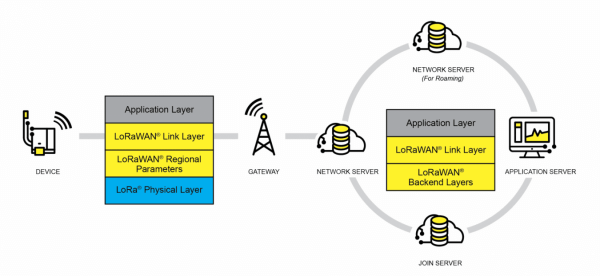
- To achieve LoRaWAN network coverage in cities or other areas, it needs to be composed of four parts: node (LoRa node radio frequency chip), gateway (or base station, LoRa gateway radio frequency chip), server and cloud, as shown in the following figure
- The DEVICE (node device) needs to initiate a network access request packet to the GATEWAY (gateway) and then to the server. After the authentication is passed, it can send and receive application data with the server normally.
- GATEWAY (gateway) can communicate with the server through a wired network, 3/4/5G wireless network
- The main operators on the server side are [TTN], etc. For building cloud services by yourself, please refer to [lorawan-stack], [chirpstack]
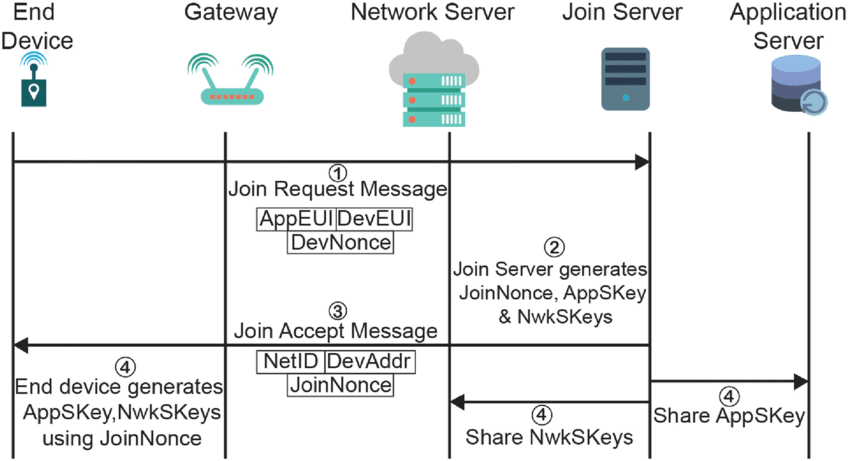
- There are two methods for Raspberry Pico and Pico-LoRa-SX1262 to connect to the network via LoRaWAN: OTAA (Over-The-Air-Activation) and ABP (Activation By Personalization). Here we use OTAA, as shown below. Also you can refer to link 1, link 2 and source code.
- Step 1: Please send the "Join-Request" message to the network to be added, and note that the adding process is always initiated by the end device. The join-Request message can be transmitted at any rate and in one of the region-specific join channels. For example: in Europe, the end device can send the join-Request message at 868.10 MHz, 868.30MHz, or 838.50MHz. Also, the message can send to the network server by one or more gateway. In addition, you need to pay attention to choosing the applicable frequency band according to the local radio management regulations. You can refer to link and LoRa Alliance for the frequency distribution table. The Join-Request message is combined by the following field, AppEUI, and DevEUI are generated by the server end.
- AppEUI: A 64-bit globally unique application identifier in the IEEE EUI64 address space that uniquely identifies an entity capable of processing Join-Request frames.
- DevEUI: A 64-bit globally unique device identifier that uniquely identifies an end device in the IEEE EUI64 address space.
- DevNonce: A unique random 2-byte value generated by the end device. The web server uses each end device's DevNonce to keep track of their join requests. If the end device sends a join request with the previously used DevNonce (this case is called a replay attack), the network server will reject the join request and will not allow the end device to register with the network.
- Step 2: The web server handles the Join-Request-Message. If the end device is allowed to join the network, the web server will generate two session keys (NwkSKey and AppSKey) and the Join-accept message. The Join-accept message itself is then encrypted using AppKey. The web server uses AES decryption operation in ECB mode to encrypt Join-accept messages.
- Step 3: The network server sends the encrypted join to accept the message back to the end device as a normal downlink.
- Step 4: The end device uses AES to decrypt Join-Accept. And uses AppKey and AppNonce to generate two session keys NwkSKey and AppSKey for subsequent communication with the Networking server. Network Server also saves kSKey, Join server distributes AppSKey to Application Server.
- The DevEUI and AppEUI parameters used as terminal devices to access the Internet need to be registered and generated by the server. The specific process is as follows:
- Register an account in TTS and log in. Create an Application.
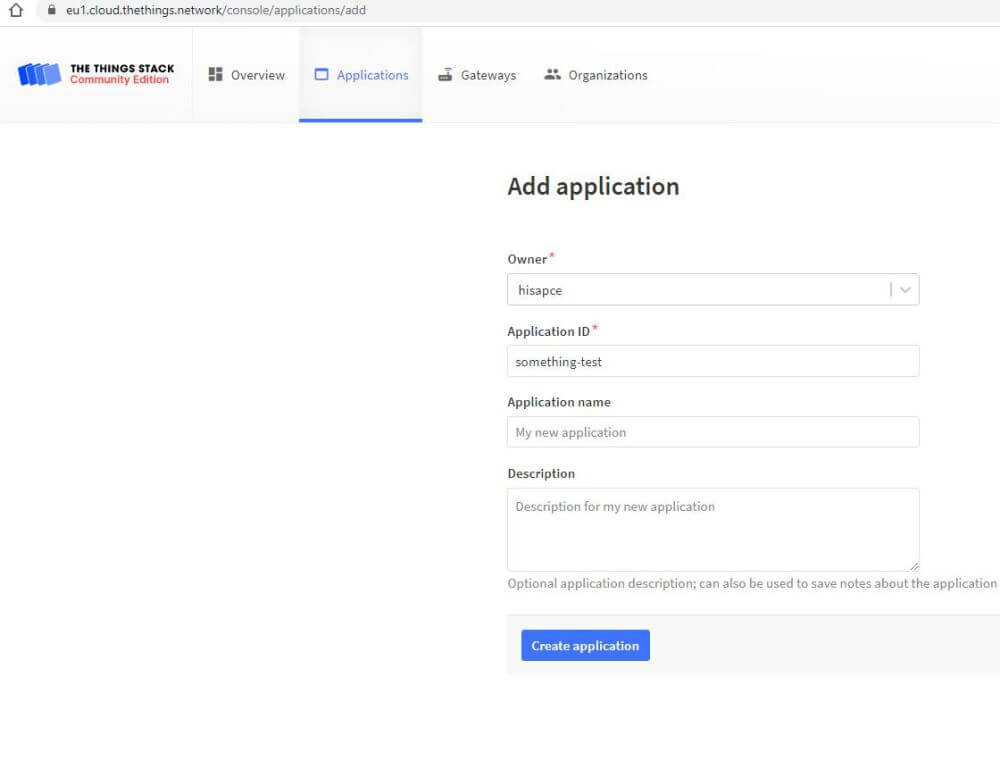
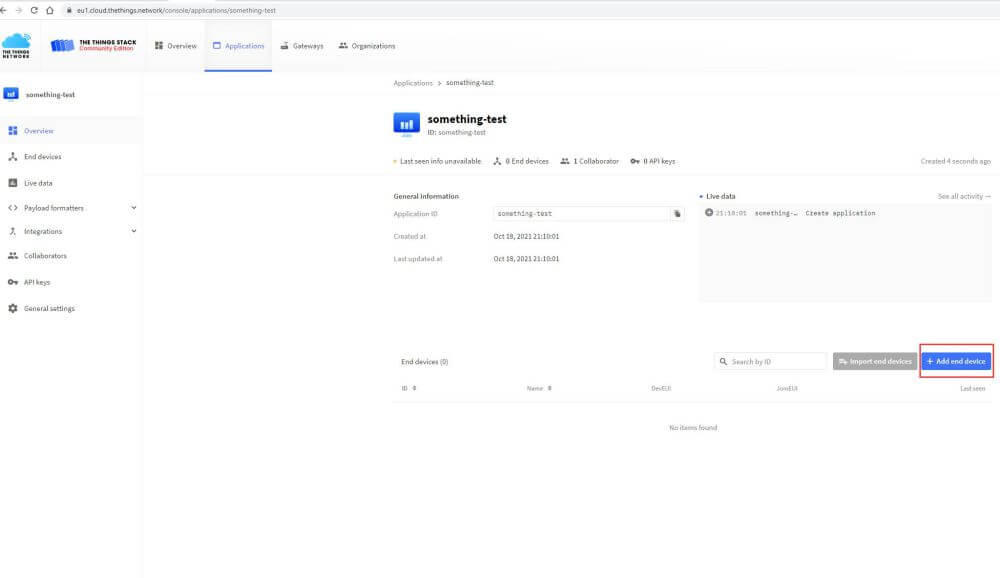
- Add an End Device
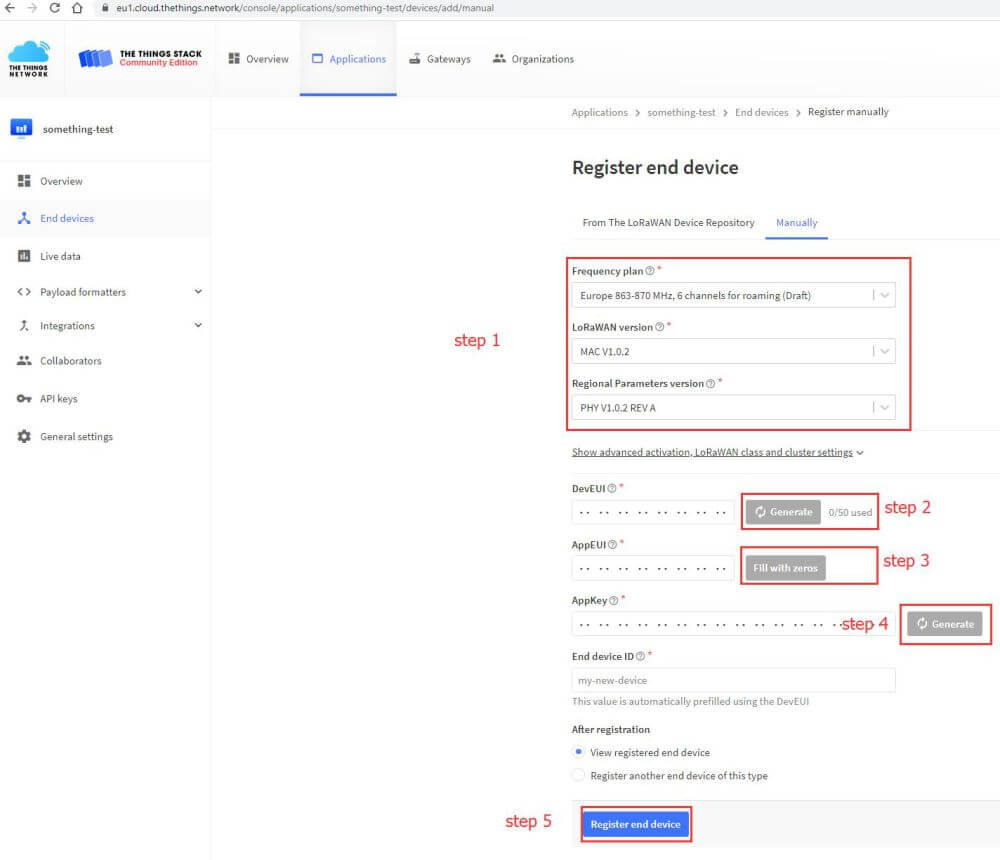
- Configure the End Device as in the picture. Please save the DevEUI and the AppKey for further use.
Application
LoRa devices and networks such as LoRaWAN enable smart IoT applications to help solve the planet's formidable challenges in energy management, natural resource reduction, pollution control, infrastructure efficiency, disaster prevention, and more. Semtech's LoRa devices have achieved hundreds of successful use cases in smart cities, homes and buildings, communities, metrology, supply chain and logistics, agriculture, and more. LoRa networks have covered hundreds of millions of devices in more than 100 countries and are committed to a smarter planet.
This product test is based on TTS (The THINGS STACK) and Semtech SX1302 official library, if users build their own cloud server, please click to refer to lorawan-stack, chirpstack.