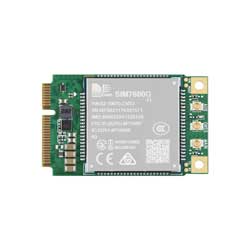




- sales/support
Google Chat:---
- sales
+86-0755-88291180
- sales01
sales@spotpear.com
- sales02
dragon_manager@163.com
- support
tech-support@spotpear.com
- CEO-Complaints
zhoujie@spotpear.com
- Only Tech-Support
WhatsApp:13246739196
- Purchase/Shipping/Refund
WhatsApp:13424403025
- HOME
- >
- ARTICLES
- >
- Common Moudle
- >
- GSM-GPS
SIM7600G-H-PCIE User Guide
Overview
The SIM7600G-H-PCIE series is the LTE Cat 4 module that supports wireless communication modes of LTE-TDD/LTE-FDD/HSPA+/GSM/GPRS/EDGE etc. It supports a maximum 150Mbps downlink rate and 50Mbps uplink rate.
The SIM7600G-H-PCIE series adopts a mini PCIe form factor and consists of a SIM7600-H series module and a mini PCIe adapter board. It is easy for customers to integrate.
The SIM7600G-H-PCIE series integrates multiple satellites with high accuracy positioning GNSS systems, with multiple built-in network protocols, supports drivers for main operation systems (USB driver for Windows, Linux and Android, etc.) and software function, AT commands are compatible with SIM7500/SIM7600 series modules.
Meanwhile, the SIM7600G-H-PCIE series integrates main industrial standard interfaces, with powerful expansibility, including abundant interfaces such as UART, USB, and GPIO, which are suitable for main IoT applications such as telematics, surveillance devices, CPE, industrial routers, and remote diagnostics, etc.
Specifications
| Frequency Band | |
| LTE-FDD | B1, B2, B3, B4, B5, B7, B8, B12, B13, B18, B19, B20, B25, B26, B28, B66 |
| LTE-TDD | B34, B38, B39, B40, B41 |
| WCDMA | B1, B2, B4, B5, B6, B8, B19 |
| GSM | 850, 900, 1800, 1900MHz |
| GNSS | GPS, Beidou, GLONASS, GALILEO, QZSS |
| Data Transfer | |
| LTE | 150 Mbps (DL) / 50 Mbps (UL) |
| HSPA+ | 42 Mbps (DL) / 5.76 Mbps (UL) |
| WCDMA | 384 Kbps (DL) / 384 Kbps (UL) |
| EDGE | 236.8 Kbps (DL) / 236.8 Kbps (UL) |
| GPRS | 85.6 Kbps (DL) / 85.6 Kbps (UL) |
| Software Features | |
| Operating system | Windows/Linux/Android |
| Protocol | TCP, IP, IPV4, IPV6, Multi-PDP, FTP, FTPS, HTTP, HTTPS, DNS |
| SMS | Supports MT, MO, CB, Text, PDU |
| Firmware upgrade | USB/FOTA |
| Hardware Specifications | |
| SIM card | 1.8V/3.0V |
| Antenna interface | IPEX-4 connector (LTE main antenna + LTE diversity antenna + GNSS antenna) |
| Power supply | 3V ~ 4.2V |
| Form factor | M.2 B KEY |
| Dimensions | 42.0 × 31.4 × 3.8mm |
| Operating temperature | -40℃ ~ +85℃ |
| Applications | |
| Applicable regions | global coverage |
| Examples | Healthcare, smart payment, Internet talk, environmental monitoring, energy monitoring, fleet management, smart industry, intelligent agriculture, etc. |
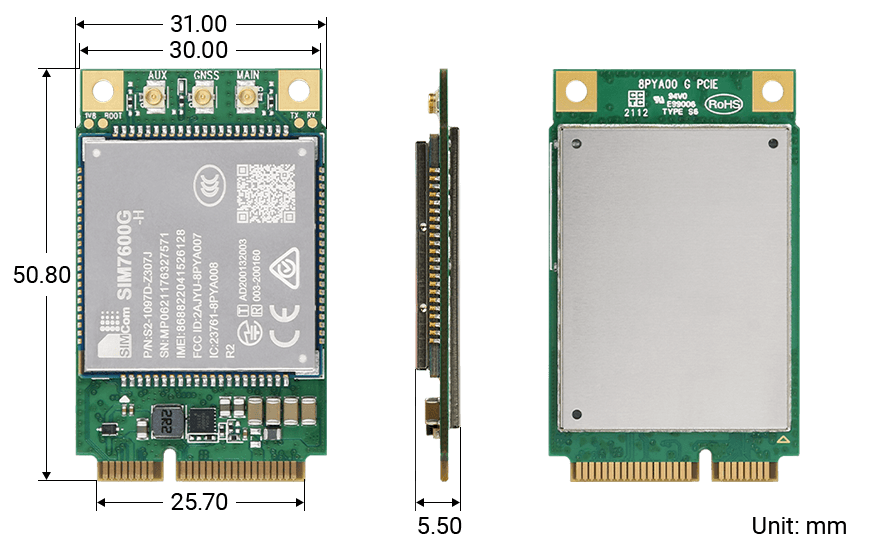
Dimensions
Notices
- DO NOT plug the module while powering.
- The supply voltage should be about 4.0V for properly working.
- Please check the interface before you use the module. M.2 B Key is not compatible with MINI-PCIE.
Indicators
| STA | NET | Status |
|---|---|---|
| ON | OFF | Turning off or turning on |
| ON | OFF | Operating |
| ON | ON | SIM card isn't inserted or weak signal |
| ON | Blink | Networking, working normal |
| OFF | Blink/ON | Shutdowning |
Please make sure that you have connected and powered the module normally before you configure it.
Set up 4G in Raspberry Pi
- Open a terminal and run the following commands to install minicom.
sudo apt-get install minicom
- Open the minicom:
sudo minicom -D /dev/ttyUSB2
- Configure the module by the following command in minicom.
AT+CUSBPIDSWITCH=9011,1,1
- Configure the port and networking.
sudo dhclient -v usb0
- If you set up the module successfully, however, it cannot be networking normally, please try to change the frequency by the AT command (just choose one of them).
AT+CNBP=0x0002000000400183,0x000001E000000000,0x0000000000000021
AT+CNBP=0x0002000000400180,0x480000000000000000000000000000000000000000000042000001E200000095,0x0000000000000021
AT commands
If the module cannot connect to the network normally, please use minicom and AT commands to check the module.
sudo apt-get install minicom
sudo minicom -D /dev/ttyUSB2
- Common AT commands
- The following commands are working for both 4G/5G modules
| Comamnd | Description | Return |
|---|---|---|
| AT | AT test command | OK |
| ATE | ATE1 to enable echo ATE0 to disable echo | OK |
| AT+CGMI | Check module manufacturer | OK |
| AT+CGMM | Check module type | OK |
| AT+CGSN | Check SN of module | OK |
| AT+CSUB | Check module version and the chip | OK |
| AT+CGMR | Check firmware version | OK |
| AT+IPREX | Set serial baud rate of module | +IPREX: OK |
| AT+CRESET | Reset module | OK |
| AT+CSQ | Check signal quality | +CSQ: 17,99 OK |
| AT+CPIN? | Check SIM card status, READY for normal | +CPIN: READY |
| AT+COPS? | Check the current network supplier, it returns supplier information if the network is normal | +COPS: OK |
| AT+CREG? | Check network status | +CREG: OK |
| AT+CPSI? | Check UE system information | |
| AT+CNMP | Select network mode: 2:Automatic 13:GSM only 38:LTE only 48 : Any modes but LTE ... .... | OK |
For more information about the AT commands, please refer to the AT command manual
For more documents, please refer to SIMCom website
For more examples, please refer to the related HAT devices of Waveshare.
Resource
- SIM7600X Hardware Design manual
- SIMCom documents
- SIM7600 Driver(Windows)
- SIM7600 Serial Debug Assistant
- GPS Debug Tool
- TCP Test Tool
- Xshell
- VLC media player
- Unicode Conversion Software
FAQ
Question:I'm trying to set it up on a Raspberry Pi 4 with Ubuntu 2. Do you have reliable setup documentation I could use to set up a network connection using your 4G hardware?
Yes, Raspberry PI's official Ubuntu is also based on Rabian; The driver installation is the same as Raspbian; You can also use RNDIS to dial without the NIC
Support
Monday-Friday (9:30-6:30) Saturday (9:30-5:30)
Email: services01@spotpear.com