




- sales/support
Google Chat:---
- sales
+86-0755-88291180
- sales01
sales@spotpear.com
- sales02
dragon_manager@163.com
- support
tech-support@spotpear.com
- CEO-Complaints
zhoujie@spotpear.com
- Only Tech-Support
WhatsApp:13246739196
- Purchase/Shipping/Refund
WhatsApp:13424403025
- HOME
- >
- ARTICLES
- >
- LuckFox
- >
- LuckFox Pico
Luckfox Pico RV1103【Tutorial on how to use UART】
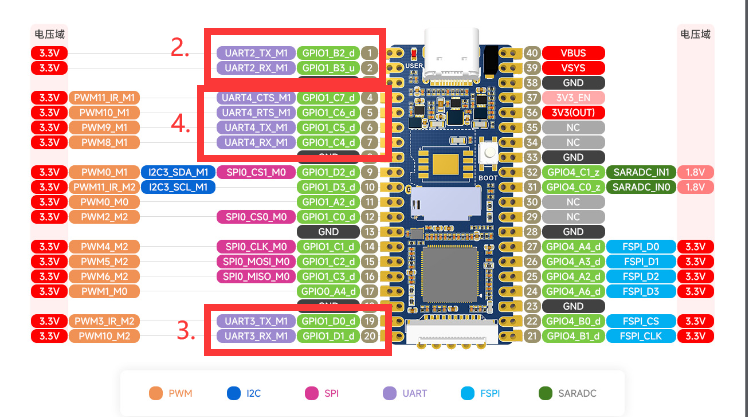
The LuckFox Pico has three serial ports: UART2, UART3, and UART4. Among them, UART2 is the debug port.
The LuckFox Pico Plus has four serial ports: UART2, UART3, UART4, and UART5. Among them, UART2 is the debug port.
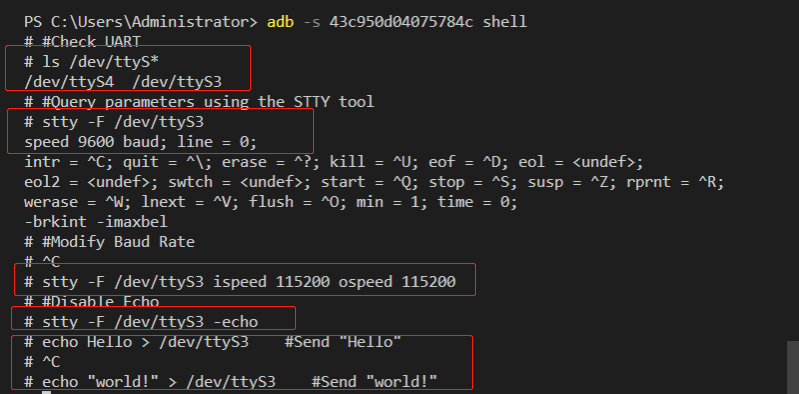
】Performing serial port testing using the GPIO sysfs interface:
1] View serial port:
root@linaro-alip:/home/linaro# ls /dev/ttyS*
/dev/ttyS3 /dev/ttyS4
##The serial port devices here are UART3 and UART4
2] Use the “stty” tool to query the serial port communication parameters:
linaro@linaro-alip:~$ stty -F /dev/ttyS3
speed 9600 baud; line = 0;
-brkint -imaxbel
##The default baud rate is 9600
3] Modify the baud rate, where ispeed is the input rate and ospeed is the output rate:
stty -F /dev/ttyS3 ispeed 115200 ospeed 115200
4] Disable echo:
stty -F /dev/ttyS3 -echo
## Disabling echo refers to the situation where the characters entered in the terminal or serial communication are no longer displayed on the terminal.
5] Operation process screenshot:
】Communicating with a Windows host:
Connect one end of the serial port module to the computer, and the other end to the physical pins 18 (GND), 19 (UART7_TX), and 20 (UART7_RX) of the LuckFox Pico.
Download and open PuTTY (or any other serial port software), select the serial port, and set the baud rate (default is 9600, please adjust it according to your actual modified value).
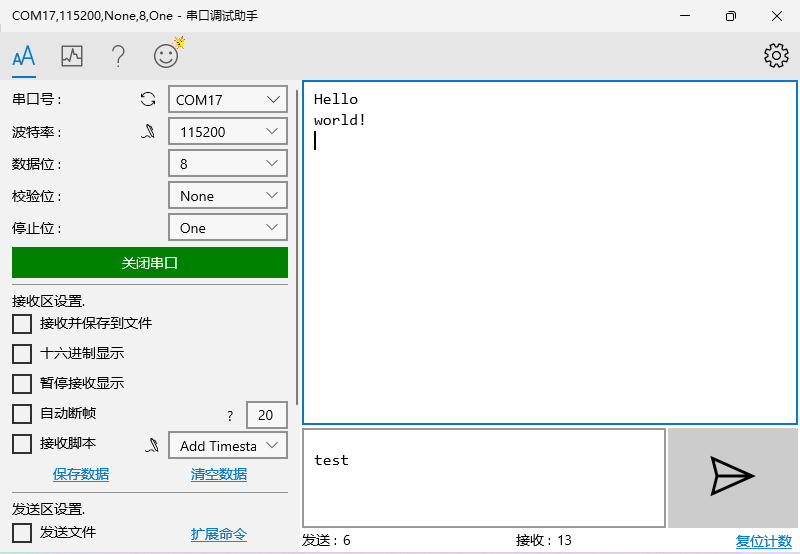
Execute the following command on the terminal of the development board to write the strings “Hello” and “world!” to the terminal device file using the echo command:
echo Hello > /dev/ttyS3
echo "world !" > /dev/ttyS3
The serial port debugging assistant on Windows will receive the content:
】Test the built-in sample program of the official SDK:
(The following operations need to be performed in the terminal of the Pico development board)
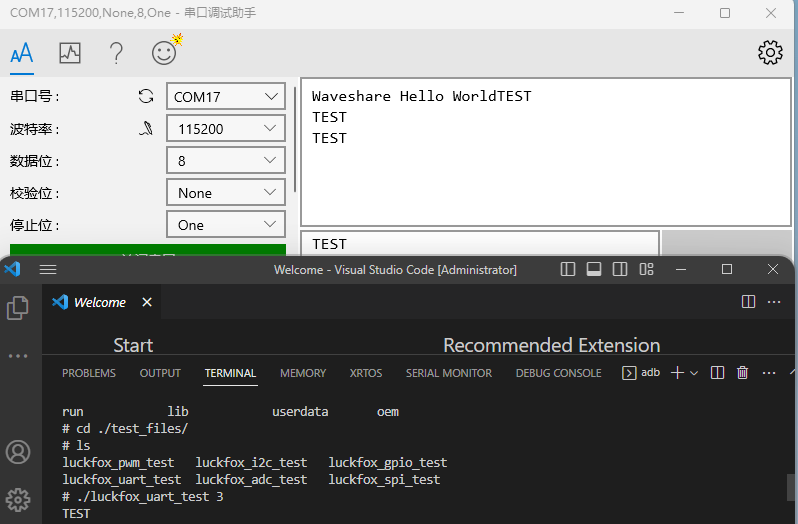
3] Run the test sample program:
chmod 777 ./luckfox_uart_test
## Grant executable permissions to the file
./luckfox_uart_test 3
##The parameter 3 in the example represents UART3.
4] Open the serial communication device to receive data:
TAG:
Core3566104032
ESP32-C6 WiFi 6 Development Board ESP32-C6-MINI-1Support WiFi6 Bluetooth5 Zigbee Thread
and Audio Speaker
WIFI Configuration
Pi5
ESP32-S3 SIM7670G 4G Development Board With Camera LTE Cat-1/4G/GNSS/GPS Global Band Portable WIFI
PC USB Monitor Screen
ESP32 P4 Development Board WIFI6 3.4 inch LCD Round Display 3.4inch TouchScreen 800×800 Dual Microphones
User Guide
Cyberpunk LED Matrix Hourglass Gravity Sensor DIY Countdown Timer Clock STEM Educational Soldering Project for Beginners & Adult
ESP32 S3 Development Board 2.8 inch Round LCD Display 480x480 QMI8658 Sensor / MIC / SD /MP3 Audio /Battery Port LVGL/HMI For Arduino
Raspberry Pi 10.85 inch e-Paper ink screen display black white 1360×480 For Arduino /Jetson /STM32 /ESP32
ESP32 S3 2.1 inch Round LCD Development Board 480x480 TouchScreen Display LVGL HMI With QMI8658C 6-Axis Sensor
RP2040 Camera
SpotPear
Modbus-Series-BootLoader-Description User Guide
Raspberry Pi CM5 IO BASE B Mini Board a Base Development Platform Compute Module 5 IO Board with EEPROM And Encryption chip
2.66inch e-Paper e-link Module 360x184 4-Color Red Yellow Black White For Arduino Raspberry Pi STM32 Jetson Tutorial Information Wiki Program Code User Guide SpotPear
Raspberry Pi Camera
Raspberry Pi User Guide
TAG:
Milk-V Duo 256M
Raspberry Pi 5
UGV Beast PT ROS2 AI 4G 5G OpenCV Robot Car MediaPipe Raspberry Pi4B Pi5
Power Manager Module
MPW2.5G Raspberry Pi 5 PCIe WiFi 7 2.5G Ethernet RJ45 RTL8125 WiFi7 WiFi6 WiFi5
5033S Power Module
Raspberry Pi 5 PCIe to SATA Expansion Board with EEPROM HAT+
ESP32 IR Thermal Imaging Camera
RTL8723 WIFI SDIO Expansion Module Board For Luckfox Pico Mini B /Luckfox Pico Plus /Luckfox Pico Pro /Luckfox Pico Max
USB camera 5MP IMX335 No Distortion
Sipeed NanoKVM-USB
LuckFox Pico pro
ESP32
Magnetic-Encode CF35-12 Servo
Raspberry Pi 5 CSI Cable
SpotPear
Luckfox Pico Camera MIS5001 5MP wide-angle lenses‌ For RV1106/Pro/MAX/Ultra (Not For RV1103 Pico)
DTM3202
Milk V
Screen