




- sales/support
Google Chat:---
- sales
+86-0755-88291180
- sales01
sales@spotpear.com
- sales02
dragon_manager@163.com
- support
tech-support@spotpear.com
- CEO-Complaints
zhoujie@spotpear.com
- Only Tech-Support
WhatsApp:13246739196
- Purchase/Shipping/Refund
WhatsApp:13424403025
- HOME
- >
- ARTICLES
- >
- Jetson Series
- >
- Jetson Kits
Jetson-nano-to-boot-the-system User Guide
Introduction
Herein mainly introduces Jetson Nano modules with 16GB eMMC memory according to official nvidia tutorial. All information is subject to the official website of nvidia.
Reference Links
- https://developer.nvidia.com/embedded/learn/get-started-jetson-nano-devkit#write
- https://docs.nvidia.com/jetson/archives/l4t-archived/l4t-3261/index.html#page/Tegra%20Linux%20Driver%20Package%20Development%20Guide/flashing.html#wwpID0E01O0HA
Hardware Preparation
- Jetson Nano module, corresponding power supply and heatsink
- Ubuntu18.04 computer host
- U disk with USB interface or mobile hard disk (USB3,0 is recommended)
- a USB data cable (Micro USB interface, for transmitting data)
Software Preparation
- Install SDK Manager and flash system configuration for Jetson Nano.
- Tutorial: SDKM flash Nano
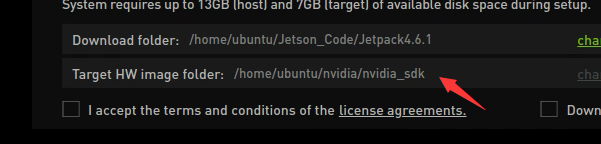
- Record the address of the downloaded HW Imager during the flashing process for later.
- Connect the U disk to the nano, and check the device number of it in the nano, such as sda.
ls /dev/sd*
- Insert the U disk to the ubuntu computer.
- Check the device number of the U disk on the computer, such as sdb.
sudo lsblk -p -d | grep sd
- Note: If your U disk has been partitioned before, it is recommended to format and adjust it to a partition on another computer first.
- Format the USB drive to ext4
sudo mkfs.ext4 /dev/sdb
- Note: Please refer to your actual situation for the specific device number. Some devices may be sda or others.
- Mount U disk
sudo mount /dev/sdb /mnt
- Enter the HW Imager address and copy the rootfs.
cd <path>/Linux_for_Tegra/rootfs/
- Note: Please refer to your actual address. For example, the author's path command:
cd/home/ubuntu/nvidia/nvidia_sdk/JetPack_4.6.1_Linux_JETSON_Nano_TARGETS/Linux_for_Tegra/rootfs/
- Copy the file system to the U disk.
sudo tar -cpf - * | ( cd /mnt/ ; sudo tar -xpf - )
- After finishing the copy, unmount the U disk, (note: don't pull it out).
sudo umount /mnt
- Set up nano as recovery mode (refer to the flashing tutorial), then connect it to the ubuntu computer and input the flashing command.
cd ../
csudo ./falsh.sh jetson-nano-emmc sda
- Note: Sda should be filled in as the actual device number of the U disk recognized by nano in the first step.
- After flashing, disconnect the nano and the U disk. Insert the U disk to the Nano before powering on it, and follow the prompts to complete the configuration.
TAG:
Raspberry Pi 5 PCIe
Industrial 4-ch RS485 DC Detection Module Modbus RTU DIN Rail
English Character Display Principle
Industrial grade isolated USB to RS232/485 converter supports USB to 2-way RS232 + 2-way RS232/485 original FT4232HL
Industrial 8-ch PWM RS485 pulse output module Modbus RTU rail
ADXL354CEZ
Raspberry Pi 10.1 inch DSI LCD TouchScreen Display 800x1280 Also For RK3576/RK3506/ESP32-P4
Raspberry Pi 5 Aluminium Case
RV1106
USB TO 2.5G Ethernet Port Converter RJ45 RTL8156B Driver-Free For Windows/macOS/Linux/Android
Raspberry Pi Pico 2 RP2350-Zero Mini Board RP2350A
HDMI to RGB
ESP32-S3 Development Board 4 inch LCD TouchScreen Display 480x480 RS485 /SHT20 /Relay For Arduino LVGL 86 TVbox
ESP32 C3 1.44inch LCD
ESP32-C3-Ornament-Trinket-LVGL-Astronaut-Clock-Watch-MINI-TV-1.69inch-Round-LCD-TouchScreen-ST7789-240x280
Raspberry Pi 5 Audio Card
Raspberry Pi Pico RP2040 C Environment Window
Industrial 4-ch PWM RS485 pulse output module Modbus RTU rail
GC9A01
PI5
TAG:
DeepSeek AI Voice Chat ESP32 S3 Development Board 2.06-inch AMOLED Display 410&amp;times;502 2.06inch TouchScreen Programmable Watch
SpotPear
Raspberry Pi Starlight Camera IR-CUT IMX462
Raspberry Pi 5 Official Case
WIFI-Kit-32
ESP32 S3 Development Board 4 inch LCD Capacitive Touch Screen 4inch Display 480×480 N16R8
AI Board
Industrial
SIM8260G M2 3G/4G/5G/GNSS/GPS Sub-6G PCIe M.2 Moudle For LTE-A/NSA/SA For DFOTA /VoLTE For SIMCOM
Raspberry Pi Long Bar Screen
LuckFox
LuckFox SC3336
Computer USB Monitor Screen
AI Machine Vision Kit OAK D S2 JPEG Encoder 12MP 4TOPS OpenCV Camera
Raspberry Pi 3.5 inch DSI Display MIPI LCD (H) Capacitive TouchScreen 480x800
RM520N GL IoT EMBB 5G 4G 3G M.2 LTE-A/NSA SA GNSS DFOTA VoLTE Quectel
Raspberry Pi RTC WatchDog HAT (B)
IMX462
Raspberry Pi Buzzer
Raspberry Pi Pico 2 RP2350 Pico2 ARM Cortex-M33 RISC-V Hazard3