




- sales/support
Google Chat:---
- sales
+86-0755-88291180
- sales01
sales@spotpear.com
- sales02
dragon_manager@163.com
- support
tech-support@spotpear.com
- CEO-Complaints
zhoujie@spotpear.com
- Only Tech-Support
WhatsApp:13246739196
- Purchase/Shipping/Refund
WhatsApp:13424403025
Writing-Image User Guide
Steps
Please note that the EMMC version does not support being booted from the SD card.
Image Download
- Download the latest Raspberry Pi image from Raspberry Pi Website.
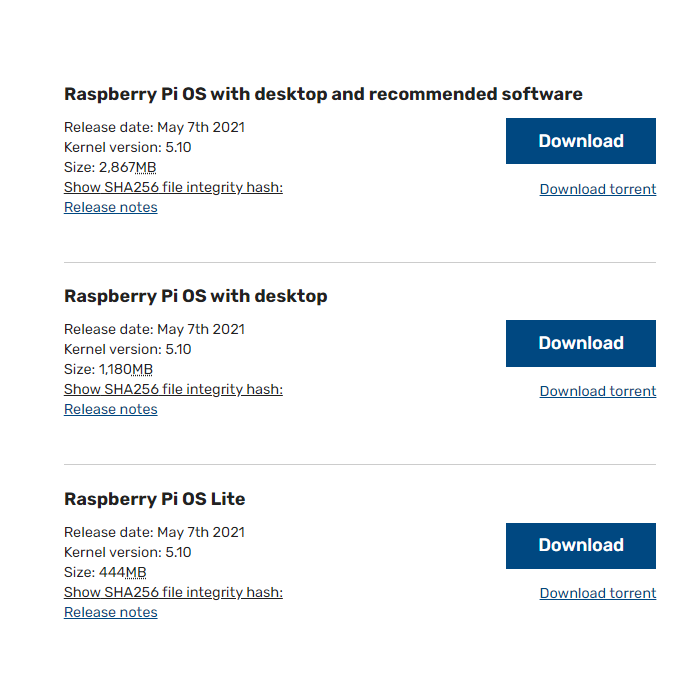
- The option "Raspberry Pi OS with desktop and recommended software" is recommended for EMMC 16G or CM4 lite 16G above memory cards.
Download rpiboot
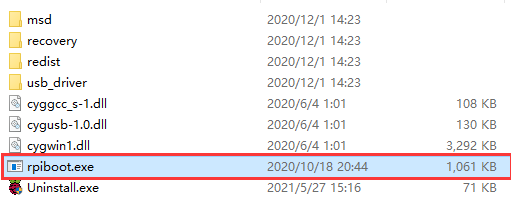
- Download and open the rpiboot software with administrator authority to install the driver and start the tool.
- After the installation is successful, there is an application of rpiboot.exe in the installation directory.
Enter Writing Mode
- Connect BOOT and GND, set the switch to ON, or just connect the USB-C port. You can check the product page to understand the location of the BOOT pin, for example:
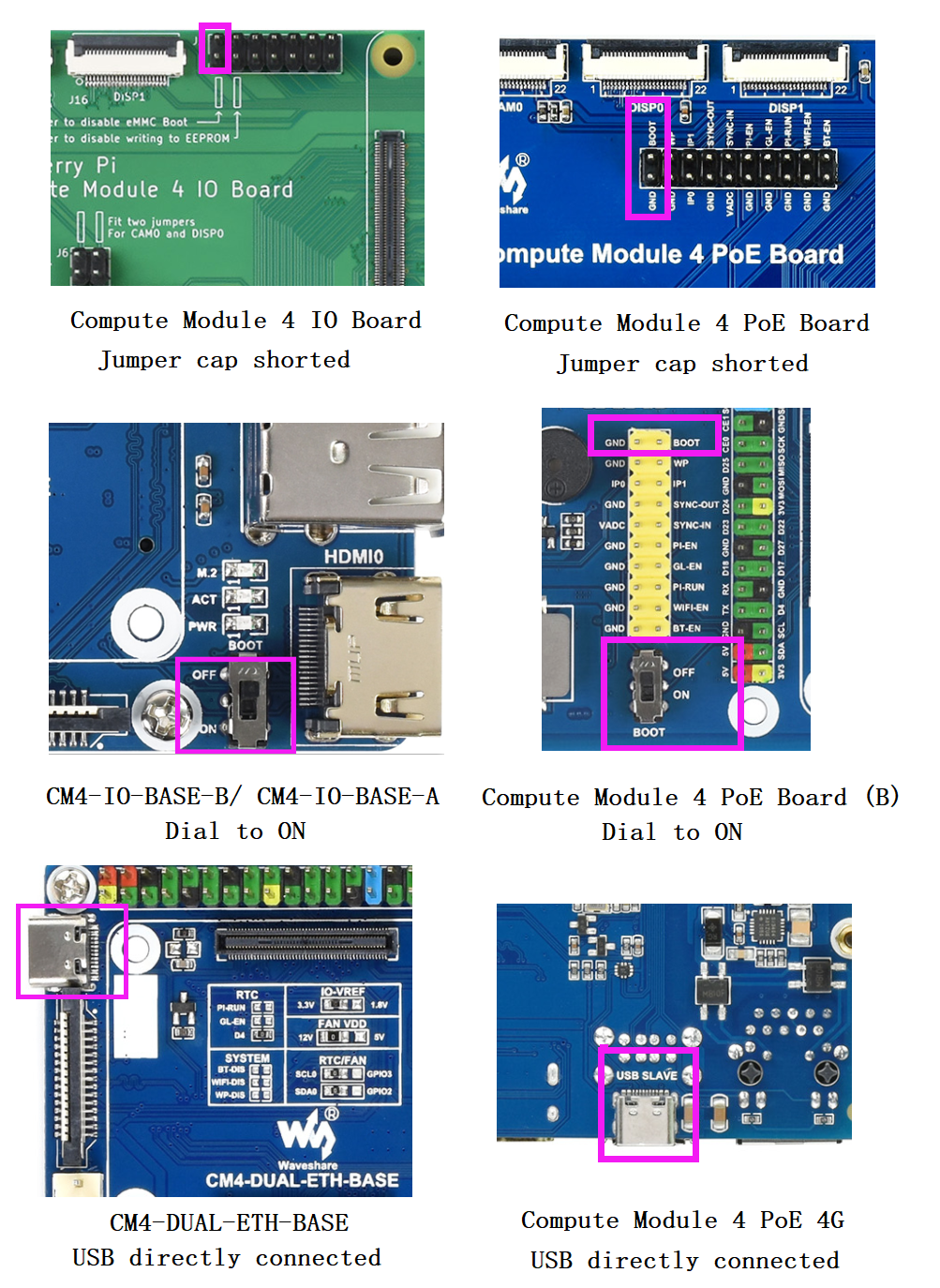
- Connect the Micro USB/Type C interface (SLAVE port) of the carrier board to the host PC, then connect a power adapter to the cattier board.
- If you use the following products, you do not need to connect the power adapter:
Compute Module 4 PoE Board
Compute Module 4 IO Board
CM4-DUAL-ETH-BASE
Compute Module 4 PoE 4G Board
- If no need external power supply:
CM4-IO-BASE-B
CM4-IO-BASE-A
Compute Module 4 PoE Board (B)
CM4-NANO-A
CM4-NANO-B
- After connecting, the boards should be recognized as BCMxxx devices on Windows PC.

- Run the rpiboot.exe as administrator (The software in the installation directory of Step 2).
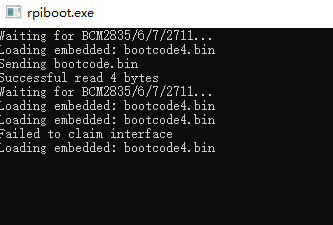
- Then the boards will be recognized as a portable disk, just format and write it with a new image.

Note: If your PC doesn't recognize the BCMxxx device, please check the connection again. Note that the USB cable used should be an OTG cable. *If you cannot write the image successfully, please try:- Use Windows 10 PC instead of Windows 7 or Linux. The other two OS are unstable as feedback.
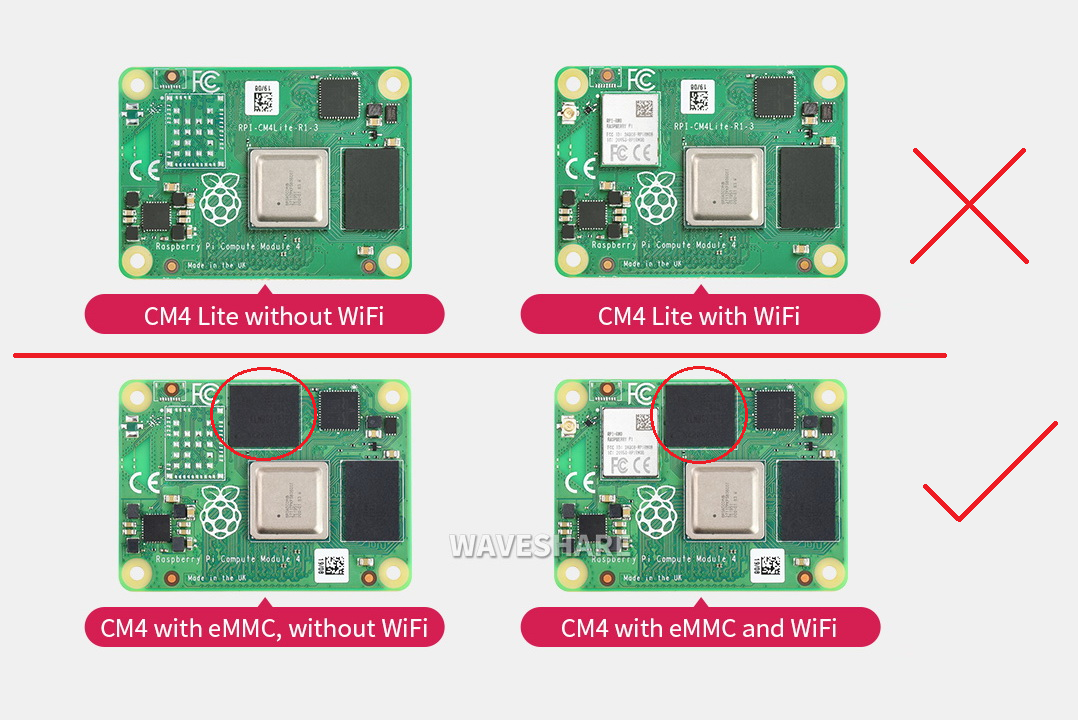
- Check if you write the eMMC version but not the Lite version. The eMMC version has one more chip than the Lite version.
- Connect a power adapter to the Power interface.
- Change to another USB OTG cable.
- Change to another USB port of the PC.
- Try to restart your host PC.
- Remount the CM4 board and try it again.
- Try with another PC.
- Check if you write the eMMC version but not the Lite version. The eMMC version has one more chip than the Lite version.
- Use Windows 10 PC instead of Windows 7 or Linux. The other two OS are unstable as feedback.
Format EMMC
- Format the SD card by SDFormatter.exe software
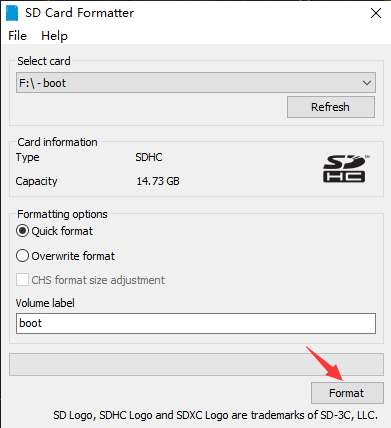
- Also, you can use the disk manager in WIN to set or delete the partition, just set the new partition after deleting the partition:
- Right-click My Computer -> Manager -> Disk Manager -> Find the new disk descriptor (Please select the correct one) -> Delete all partitions -> Create a partition (any file system) If you have programmed the system, there will be two disk descriptors, all you need to do is format it directly or delete the partition.
Write Image
- Write the Raspberry Pi image by Win32DiskImager.exe software.
- Choose the image file and click "Write" to start. It may prompt whether to format it after writing, please ignore it.
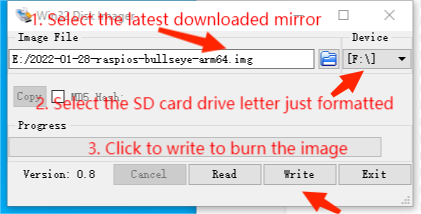
- After writing, in My Computer, a USB flash driver descriptor is recognized.
- Note:
- If you use the latest Raspberry Pi OS (image after October 30, 2021) USB2.0 is OTG mode by default, CM4 will report an error:
config failed, hub doesn't have any ports! (err -19)
- However, USB is still available. If you want to remove this error, remove "otg_mode=1" in [cm4] of config.txt, and add "dtoverlay=dwc2, dr_mode=host" (USB cannot be recognized without adding it).
dtoverlay=dwc2,dr_mode=host

- If you use the latest Raspberry Pi OS (image after October 30, 2021) USB2.0 is OTG mode by default, CM4 will report an error:
Reboot
- Power off after writing images, just disconnect it from the computer. Turn off the BOOT key or switch it off. Then reboot it.
TAG:
Raspberry Pi MIPI
VGA to LVDS
Industrial Grade Isolated USB TO RS232/485 (B) Serial UART Converter FT232RNL For Wall/Rail-Mount
Milk V Duo
Tang Nano FPGA Demo Code
ESP32-C6 2.16inch AMOLED Display AI Development Board 480×480 2.16 inch TouchScreen Deepseek
ESP32-S3 1.43inch AMOLED Display AI Development Board 466×466 1.43 inch TouchScreen Deepseek
Servo
RP2040 LoRa-HF
OLED-LCD-HAT-A
SPI Communication
Serial Bus Servo
2.13inch e Paper HAT+ Black-White 250x122 E-Ink For Raspberry Pi /Jetson Nano /Sunrise X3 Pi /Pwnago
Industrial USB TO RS232/485 (C) UART FT232RNL 2m For 3.3V / 5V For Switchable RS232/RS485
ESP32-S3 Development Board 1.85 inch Round LCD N16R8 DeepSeek AI Voice Chat Robot BOX Magnetic-charging
ESP32 C3 Zero
ESP32 C5 Development Board 2.73 inch LCD Display Screen ILI9488 For Dual band WiFi Onborad SD-Port
Sipeed NanoCluster Mini Cluster Board mini data center For Raspberry Pi CM45 / Computer /LM3H /M4N
Raspberry Pi 8.8 inch DSI MIPI Display LCD Capacitive TouchScreen 480x1920
HDMI to TTL
TAG:
Intel Wireless WLAN BE200 WiFi7 Bluetooth 5.4
ESP32-S3 ETH Camera PoE OV2640 OV5640
STM32 programmer
Wireless RTL8822CE NIC 2.4G 5GHz Dual Band WiFi High Speed Wireless Card RTL8822CE-CG core
USB Camera 2MP PS5268 USB 2.0 Dual-Mike Wide Dynamic range
Raspberry Pi 5 POE
ESP32-P4 PICO Development Board with MIPI DSI 10.1-inch Display
2.4Ghz-Rod-Antenna SeeedStudio-XIAO C3 S3
FT232RNL USB TO TTL Industrial UART (C)
Raspberry Pi Pico 1.14inch LCD
Raspberry Pi Pico 2 RP2350 GEEK 1.14 inch LCD
FT232RNL USB RS232 485 422 TTL
X1201 Raspberry Pi 5 UPS
ESP32-S3 AI Voice Dialogue Robot Mechanical Dog Development Board Toy Tabletop Pet Deepseek
Raspberry Pi 5
Pi5 Active Cooler
RS422 to CAN
Industrial Modbus RTU RS485 4-ch Relay With isolation protection and guide rail
Pi5 Fan
ESP32 IR Thermal Imaging Camera